RSS
Maximum source coverage, flexible conventions, and common full-content extensions.
RSS implementationSyndication + normalization
RSS, Atom, JSON Feed, and Markdown can share one summarization pipeline when their original semantics are preserved during normalization.
Format map
A robust consumer supports multiple formats and evaluates completeness, stability, identity, and update behavior per source.
Maximum source coverage, flexible conventions, and common full-content extensions.
RSS implementationTyped content, explicit link relations, stable IDs, and required update metadata.
Atom implementationDeveloper-friendly JSON with explicit text, HTML, author, tag, and attachment fields.
JSON Feed implementationA readable intermediate representation for normalized headings, lists, code, and links.
Markdown workflowData model
Every parser should produce the same core fields while preserving format-specific values.
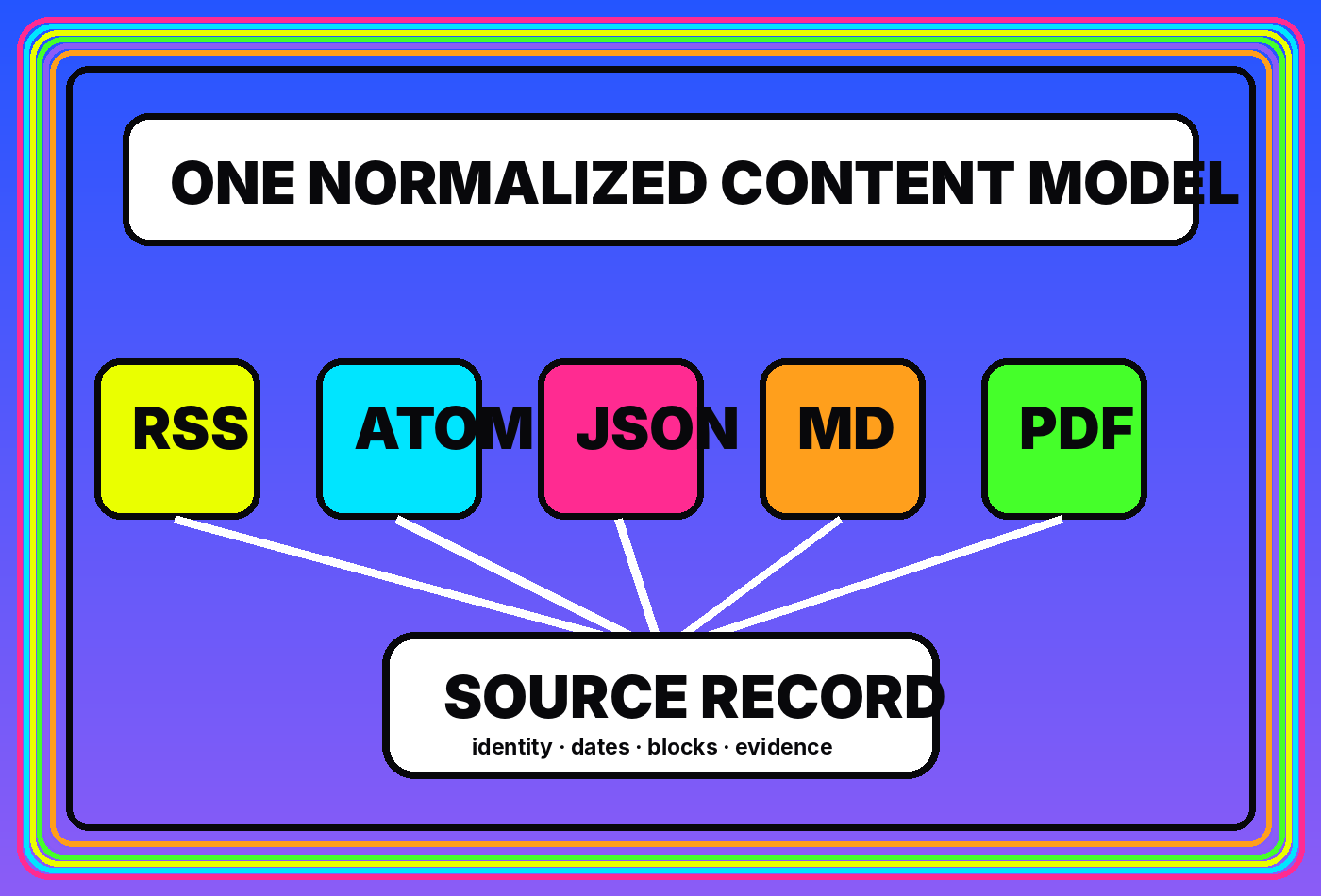
Normalization rules
Preserve ambiguity instead of hiding it.
Do not assume every RSS GUID is a URL, every Atom update is a publication date, or every JSON date is present. Keep original strings and the mapping decision.
Use source-scoped IDs, canonical URLs, and content fingerprints together.
Retain the difference between summary and full content, text and HTML, alternate and self links, and article versus enclosure resources.
Convert meaningful content into blocks before chunking, and record when only an excerpt was available.
Feed Signals
A developer-focused comparison of RSS, Atom, and JSON Feed.
A developer-focused comparison of RSS, Atom, and JSON Feed for ingestion, normalization, and AI feed summary systems.